Real-Life Strength:
Why Consistency Beats Duration in Midlife
By Alison Powers
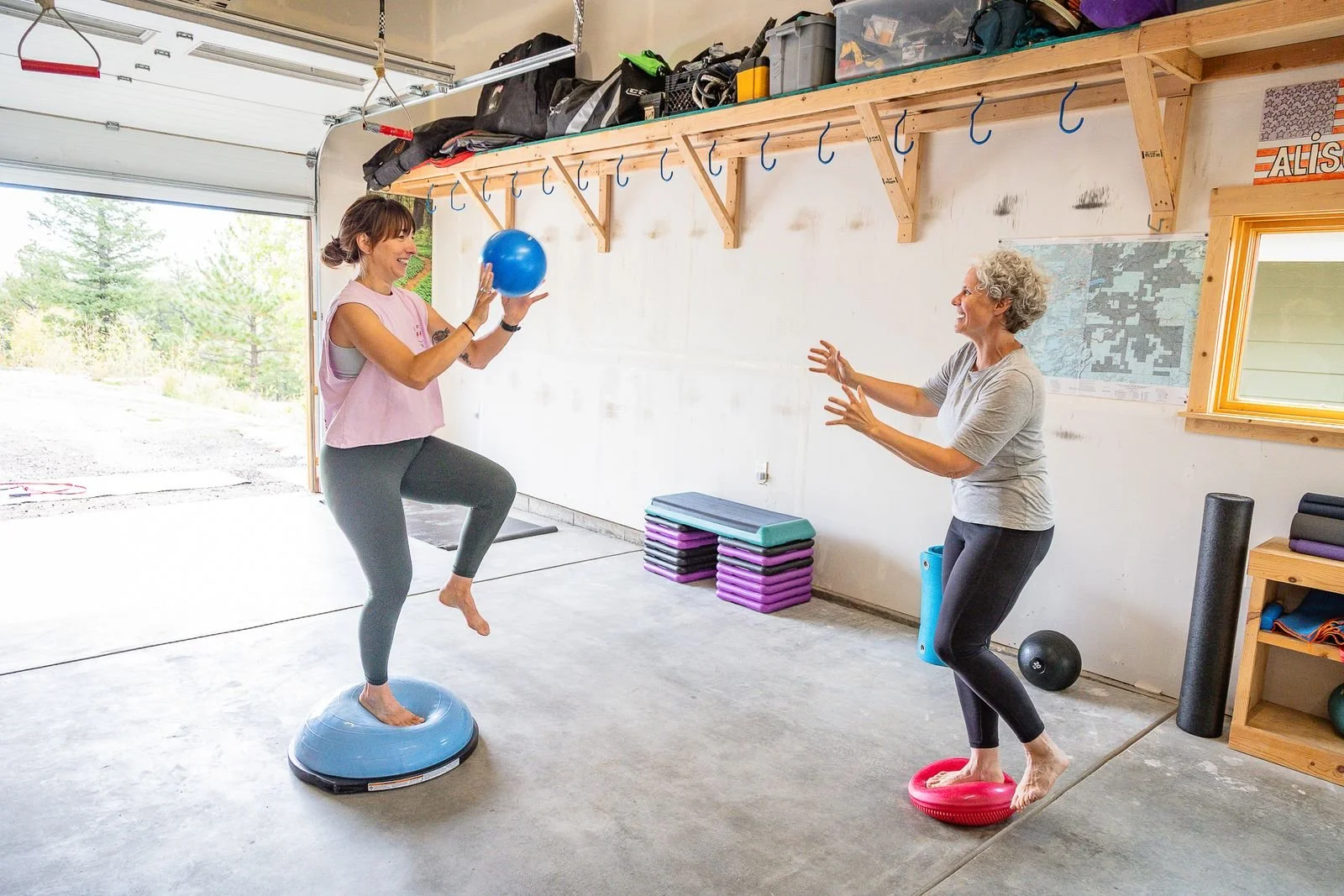
Midlife can feel like a balancing act of career & family demands, leaving zero time for exercise and healthy eating. But there is an elephant in the room that must be discussed. If you don't build healthy lifestyle habits now, you will spend the last 15 to 20 years of your lifespan trapped in a body that cannot move, balance, or lift its own luggage.
In 2018, Harvard published a study “Impact of Healthy Lifestyle Factors on Life Expectancies in the US Population” that found midlife (roughly ages 40–60) is when lifestyle choices accumulate enough impact to strongly affect what your 70s and 80s look like. If you want to have an active retirement, free of chronic disease, then you must make time now to take care of your health.
The good news is the exercise that benefits us most in mid-life is time efficient. Workouts can be short consistent “snacks” done at home as opposed to hour long slogs with a drive to and from the gym. The first place to start is strength training. The goal of strength training is to prevent Sarcopenia. Sarcopenia is the progressive loss of muscle mass, strength, and physical performance that occurs with aging. It is one of the best-documented reasons that two people of the same age can have very different levels of function and independence later in life.
Strength training doesn't require a gym membership or hours of free time; it can easily be done at home with zero equipment. Your movement can range from a quick set of squats between meetings to a focused 30-minute full-body circuit. The critical and hardest step is simply to start. Use the pocket of time you have right now and get moving. To build a routine that fits your life, utilize online resources or partner with a personal trainer who can teach you the foundational basics tailored specifically to your body and your schedule.
Next is cardiovascular fitness. Cardiovascular fitness lowers risk of cardiovascular disease, protects the brain, improves metabolic health, builds resilience against illness, and is associated with a longer life span. During midlife, the quality of your cardiovascular training matters more than the quantity. This is exactly where Sprint Interval Training (SIT) comes into play. In as little as 20 minutes, a targeted SIT session can stimulate profound cardiovascular and metabolic adaptations, dramatically improving both our bodies and our overall health span (the period of a person’s life spent in good health, free from chronic disease and the debilitating disabilities of aging). A 20-minute example SIT session is: (choose any activity you enjoy) 7 minute progressive warm-up then 4 x 30 seconds all-out, 2 minutes recovery, 3-5 minute cool down.
It’s important to remember that while this article is on mid-life fitness, the same rules apply to fitness and health for later adulthood. You can improve your current health and wellbeing starting right now by moving, exercising, and building strength.
Every living being requires movement to stay mobile, vibrant, and healthy. We’ve all heard the adage, 'where there’s a will, there’s a way'—but in midlife, it’s about finding creative ways to weave fitness into your day. If you’re struggling to balance family time with exercise, take a walk together and toss in walking lunges. Instead of meeting a friend for happy hour drinks, challenge each other to a quick SIT workout followed by a healthy dinner. And before you unconsciously reach for the snacks between meetings, drop and do 10 push-ups. It all adds up.
“We don't stop exercising because we get old; we get old because we stop exercising.”